
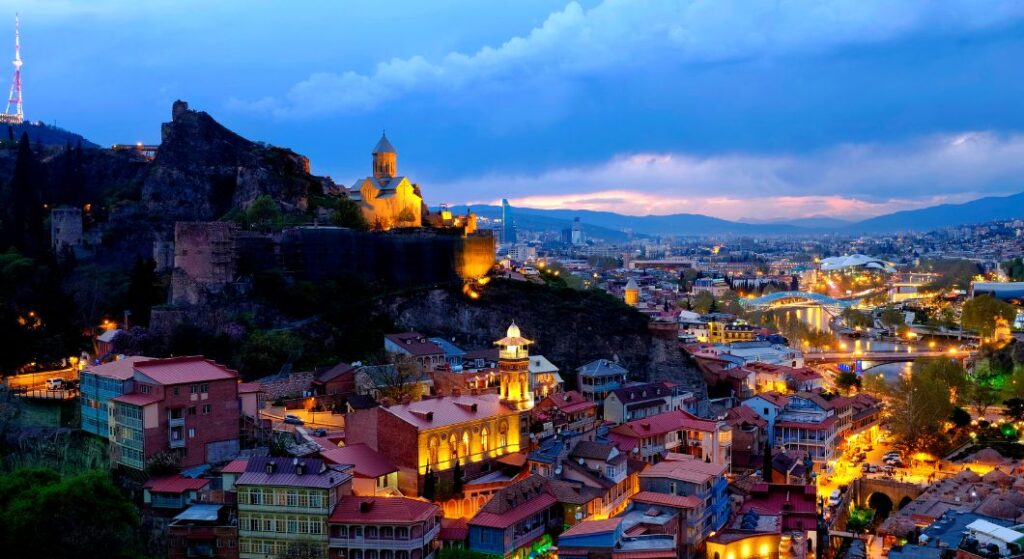
I didn’t plan to stay five days in Tbilisi. I booked three nights, told myself I’d move on to the mountains, and then just… didn’t. Something about the city makes it surprisingly hard to leave — and I don’t mean that in a poetic way. I mean the wine is cheap, the food is excellent, and every time I thought I’d seen enough, I’d turn a corner and find something worth another hour of my time.
This is my honest take on Tbilisi — what’s worth your time, what’s overrated, and what a mid-range traveler should actually expect to spend.
Why Tbilisi deserves more than a stopover
Most people treat Georgia as a pit stop between bigger destinations. That’s a mistake. Tbilisi is a proper city with a personality — it’s part Soviet, part medieval, part hipster café district, and entirely its own thing. The old town looks like it was designed by someone who loved Moorish architecture but had access to Georgian wine. Which, knowing the culture, is entirely plausible.
It’s also one of the most photogenic capitals in Europe — and yes, Georgia counts as Europe depending on who you ask and how far you’re willing to stretch a definition. The price-to-experience ratio here is still genuinely good, though it’s crept up over the past couple of years as more travelers figure out what locals have known forever.
When to go to Tbilisi
Spring (April–June) and autumn (September–October) are the sweet spots. The weather is warm without being punishing, the hills around the city are green or golden depending on the season, and the tourists haven’t completely taken over the popular spots yet.
Summer gets hot — properly hot, mid-30s Celsius — and the city doesn’t stop, but you’ll be sweating through every uphill street in the old town. Winter is mild by Eastern European standards but rainy, and some mountain destinations nearby shut down or become harder to access.
Go in May if you can. The roses are out, the terraces are open, and the whole city seems to be in a good mood.
Getting to Tbilisi
By air: Tbilisi International Airport (TBS) is well-connected to major European hubs. Budget airlines like Wizz Air and Ryanair serve it from several European cities, and you can often find reasonable fares if you book a few weeks out. The airport is about 20 minutes from the city center by taxi — expect to pay around 30–40 GEL (roughly €10–13) via Bolt or Yandex, which are both widely used here. Don’t take an unmetered cab from the arrivals hall unless you enjoy negotiating.
By land: From Armenia, Turkey, or Azerbaijan, there are bus and marshrutka connections. The Tbilisi–Yerevan route is popular and takes around 5–6 hours. It’s not glamorous, but it’s cheap and the border crossing is usually straightforward for EU passport holders.
Getting around the city
Tbilisi’s public transport is genuinely decent. The metro covers the main areas and costs 1 GEL per ride (about €0.35). Buses fill in the gaps. You’ll need a Metromoney card, which you can pick up at any metro station for a small deposit.
For everything else — and there’s a lot of everything else, because Tbilisi’s old town involves some steep hills — Bolt works well and prices are low. A ride across the city center rarely costs more than 5–7 GEL.
The cable car from Rike Park up to Narikala Fortress is worth taking at least once. It costs 2.50 GEL each way and saves you a sweaty climb. The views from the top are legitimately good.
Where to stay in Tbilisi
The old town (Abanotubani and Kala districts) is the obvious choice for first-timers — you’re walking distance from most of what you’ll want to see, and the streets are atmospheric in a way that Airbnb descriptions consistently fail to convey. The downside is that it’s hilly, some streets are cobbled into inconvenience, and accommodation prices are slightly higher than elsewhere.
Budget option: Hostels in the old town run around €15–20/night for a dorm, €35–50 for a private room. Quality varies a lot — read recent reviews carefully.
Mid-range pick: Boutique guesthouses are where Tbilisi really shines at this price point. For €50–80/night you can get a room in a renovated traditional house with a wooden balcony, exposed brick, and a host who’ll recommend restaurants that aren’t on TripAdvisor yet. This is the sweet spot.
If you want something more polished: Marriott and Radisson have properties here, but they feel oddly out of place. You’re in Tbilisi — stay somewhere that feels like it.
The Marjanishvili and Vera neighborhoods are good alternatives if the old town feels too touristy. Younger, more local vibe, slightly cheaper, still easy to get around from.
What to do in Tbilisi
Wander the old town without a plan first
I know that’s not actionable advice, but it’s genuinely the right move for your first half-day. The old town rewards getting slightly lost. The carved wooden balconies, the crumbling walls next to freshly renovated wine bars, the cats on every doorstep — it reads differently when you stumble onto it than when you tick it off a list.
Narikala Fortress
The fortress dates back to the 4th century and sits on the ridge above the old town. You can walk up (steep but manageable), take the cable car, or combine both. The ruins themselves are atmospheric rather than spectacular — this isn’t Dubrovnik — but the views over the sulfurous bath district and the city below are worth the trip up regardless.
Abanotubani — the sulfur bath district
The domed bathhouses at the base of the fortress have been here for centuries. The sulfur water is natural, hot, and supposedly good for various things. A private bath room for two hours costs around 25–40 GEL depending on the establishment. It’s genuinely relaxing, slightly sulfurous in smell, and a good way to spend a couple of hours if you’ve done a lot of walking.
Chreli-Abano and Gulo’s Thermal Spa are both solid options. Book ahead on weekends.
Rustaveli Avenue and the National Museum
Rustaveli is the main boulevard — wide, tree-lined, full of theatres and grand Soviet-era buildings. The Georgian National Museum on Rustaveli is excellent, particularly the Gold Treasury section, which requires a guided tour but is worth it for the ancient jewelry alone. Budget 2–3 hours and about 20 GEL entry.
The Dry Bridge Market
Every weekend, the Dry Bridge fills up with vendors selling Soviet memorabilia, old coins, icons, paintings, and an enormous amount of stuff that probably came out of someone’s grandmother’s attic. It’s a proper flea market, not a curated craft fair. You can find interesting things here if you’re patient — old cameras, vintage maps, military insignia. Bargaining is expected and part of the experience.
A day trip to Mtskheta
Mtskheta is the ancient capital of Georgia, about 20 kilometers from Tbilisi. It’s a UNESCO site, home to the Jvari Monastery (perched dramatically on a hill at the confluence of two rivers) and the Svetitskhoveli Cathedral. It’s doable in half a day and genuinely impressive. Take a marshrutka from Didube bus station for about 1.50 GEL, or grab a Bolt for around 15 GEL each way.
Where to eat in Tbilisi
Georgian food is one of the underrated cuisines of the world, and Tbilisi is the right place to discover this.
Khinkali are the dumplings — thick dough, juicy filling (pork and beef is classic, but mushroom versions exist for vegetarians), eaten by holding the knot on top and biting into the side first to catch the broth. They’re sold by the piece, usually 1.50–2 GEL each. Order eight and see how you feel.
Khachapuri is the cheese bread situation that comes in several regional variations. The Adjarian version — boat-shaped, filled with cheese, with a raw egg and butter dropped in at the end — is the one you want. It’s not health food. It’s very good.
For a solid, unpretentious local meal, look for a Georgian canteen-style place (locally called a stolovaya in the Soviet tradition) where you point at what you want and pay almost nothing. Lunch here costs 8–12 GEL including a drink.
Shavi Lomi in Vera neighborhood is worth the slightly higher price — creative Georgian cooking in a relaxed setting, mains around 20–30 GEL. It’s popular so book ahead or go early.
Ezo in the old town is good for wine and small plates in a courtyard setting. Very Instagram-friendly, which I mention only as a warning and an explanation for the slight queue on weekends.
For wine — and you should drink wine here — Georgia is one of the oldest wine-producing regions in the world. Amber wine (made with extended skin contact) is the local specialty and tastes nothing like what you might expect from white wine. A glass costs 5–10 GEL in most places. A whole bottle from a shop costs 15–25 GEL for something genuinely good.
What to skip
The Fabrika complex — a repurposed Soviet sewing factory turned into a hostel/bar/creative space — is fine, but it’s squarely aimed at tourists and has lost whatever edge it might have had a few years ago. Worth a coffee, not worth making a destination of it.
Tourist restaurants on the main drag near the old town — the ones with laminated menus and photos of every dish. They’re not terrible, but they’re not Georgian food at its best either. Walk one street away and the quality goes up, the prices go down.
Budget snapshot (mid-range traveler)
| Category | Daily estimate |
|---|---|
| Accommodation | €50–70 (boutique guesthouse) |
| Food & drink | €20–30 (mix of local and sit-down) |
| Transport | €3–5 (metro + occasional Bolt) |
| Activities | €5–15 (museums, cable car, baths) |
| Total | ~€80–120/day |
You can do it cheaper — drop to a hostel private room and eat mostly local canteens and you’re looking at €40–50/day. You can also spend more if you’re doing wine tastings and nicer restaurants every night.
Is Tbilisi worth it?
Yes. Unambiguously yes — and I don’t say that about every city I visit. It has the rare quality of feeling genuinely lived-in rather than arranged for tourists, even as more tourists arrive every year. The food is excellent, the wine is cheap and interesting, the architecture is unlike anywhere else in Europe, and the people are — in my experience — genuinely hospitable without it feeling performative.
Go before it figures out what it’s worth.